11.30.2007

Will Phil's new deal keep Kobe in LA?

Phil Jackson loves LA. He loves the short commute from his Playa Del Ray home to the Lakers practice facility in El Segundo. He presumably loves born and bred Los Angelian and owner’s daughter Jeanie Buss. He certainly loves the laid back California vibe. And now, he also apparently really loves the 2 year $24 million contract extension he got from the team.
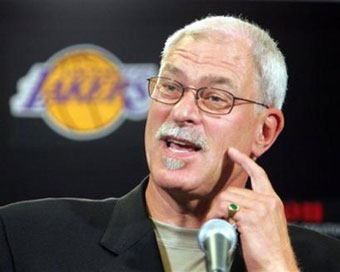
But, while we’re happy for Phil and his 24 million new GWs, the first thought that came to mind when hearing this news, just like every other Laker-watcher we’re sure, was, "does this have any Kobe implications." Jackson himself was quick to address that question, telling a press room full of curious media on Thursday night, "The decision to return as coach and the decision to be asked to return as coach both had very little to do with Kobe Bryant and very little to do with the talent. It's about the situation here -- the proximity that I feel to this organization, the comfort I feel working for this organization and the progress I think we're making."

Ok, fair enough Phil. We understand that you can’t speak for Kobe. The proper messaging, for you folks in PR, was for Phil to address his own situation and not create unnecessary news by tieing it into anything related to Kobe, the trade demands and the summer of discontent. As always, nicely played Phil. Still, while $24 million is certainly plenty compelling, Jackson isn’t hurting for money or employment opportunities should he decide to leave Los Angeles. So, why then do you lock yourself in to 3 seasons with a team and an organization that seems to be teetering on the edge of chaos?

The Lakers squad as it is constituted today is nowhere near championship caliber. Young players like Jordan Farmar and Andrew Bynum, while showing some talent of late, is just as apt to induce a migraine headache with their still inconsistent play, as they are to garner praise. The GM is inept. They’re possibly one long losing streak, or Kobe outburst away from all hell breaking loose. The owner’s son doesn’t get along with the team’s superstar, and the superstar’s personality is bi-polar at best. So, unless Phil knows something that we don’t, as much as he loves LA and the $12 million per season, the extension just doesn’t add up.

Is the house that Jerry, Phil and Kobe built getting structural reconstruction behind the scenes? No-one on the outside looking in, from sports writers to fans, know the answer, but the circumstances, as they are, certainly make you wonder.

What we do know though is that Kobe seems happy – or happier. His much-maligned teammates are playing relatively well, he seems content with the role of facilitator and everyone is all smiles.

"I think it's great," Bryant said of the signing. "He's clearly, in my opinion, the greatest coach of all time. When you can lock him in, that's always a great sign."

Sign of what? That the Lakers are finally showing Kobe that they are serious about winning?

11.27.2007

The NBA becomes upside down; We become scared

Just wanted to double-check, but did the space-time continuum spontaneously reverse itself on Monday night? Are we now living in a parallel universe? Is this what the Wachowski Brothers were going for with The Matrix? Seriously, what else could explain what happened last night in the NBA?

The underdog became king, as just about every league powerhouse lost, and some in blowouts, to the season’s bottom-dwellers. It was like revenge of the nerds, where Beno Udrih played Louis Scholnik and Tim Duncan was Stan Gable. The Sacramento Kings beat down the San Antonio Spurs 112-99, the Golden State Warriors outscored the Phoenix Suns 129-114, the Gilbert Arenas-less Washington Wizards took out the Dallas Mavericks 110-98, the Minnesota Timberwolves surprised the New Orleans Hornets 103-94 and even the lowly New York Knicks, given all of their off-court issues, took out the Utah Jazz 113-109. Only the underperforming Houston Rockets, who beat the Los Angeles Clippers 88-71, and the Orlando Magic, who bested the Portland TrailBlazers 85-74, escaped the foreboding clutches of “upset Monday” in the NBA.

Maybe, what’s happening in college football is contagious?

We hope not, because there needs to be a certain order to things. Edward Lorenz and his Chaos Theory can keep itself out of the NBA, thank you very much. Every year, there are teams that are good and teams that are bad, and the predictability and comfort that comes from that knowledge can spur euphoria when in the rarest of cases a 8 seed like last year’s Golden State Warriors upsets the 1 seed Dallas Mavericks. In that case, the event was unpredictable and unusual. That’s what made it special. But, when this becomes a regular occurrence we end up with widespread parity. And upsets become almost expected. That homogeny works perhaps in the NFL where parity is king, but can’t be useful for David Stern’s NBA.

The NBA has always thrived when there were powerhouses to rule the land. The proper order of things, dictated the repeated Finals match-ups between the Boston Celtics and the Los Angeles Lakers in the 80s. It influenced the yearly Eastern Conference playoff rivalries in the 90s amongst the Chicago Bulls, Indiana Pacers and New York Knicks. It drove Sacramento and Portland fans to absolutely and unconditionally hate the Los Angeles Lakers teams of Shaq and Kobe. It defined rivalries and added a necessary level of predictability to every NBA season.

So, please leave us alone Mr. Parity. The NBA needs the dominant players, the teams you love to hate. It needs repeat champions. It needs a general order to things. Nights like Monday can be fun in moderation, but let’s not make it general practice.

11.26.2007

Old School Baller of the Week: Bobby Jones

Mr. Peabody and Sherman are nowhere to be found, but the Wayback Machine is in full effect on the "Fans' Voice" NBA blog. Starting now, every week during the NBA season we'll take a trip back in time and profile one old school NBA baller. Generally, the NBA ol' timers profiled here won't be your household stars with names like Chamberlain and West, but rather the forgotten stars that had a significant impact on the game. Because, boys and girls, without the NBA (...and ABA) pioneers that came before we wouldn't have the game we so love today. Knowledge is power, as they say. And believe us, we expect these posts to be a cathartic exercise for us as well, as we hope to use this forum to brush up on our own familiarity with NBA history. On to this week's "Old School Baller of the Week".

Name: Bobby Jones
Position: Small Forward/Powar Forward
Height/Weight: 6'9"/210 pounds
Teams: Denver Nuggets, Philadelphia 76ers

What made him so special?

Robert Clyde Jones, or otherwise known as Bobby, played 12 season of pro ball – 2 in the ABA, followed by 10 seasons, mostly with the Philadelphia 76ers, in the NBA. During that playing career, which lasted from 1974 to 1986, Jones was named to the All-NBA, or ABA, defensive team a whopping 11 times and was selected 5 times to the All-Star team. Jones was also the consummate team player, as his teams made the playoffs every single year he played pro ball. Jones won an NBA championship toward the end of his career in 1983 with the Philadelphia 76ers of Julius “Dr. J” Earving and Moses Malone, and was presented with the NBA sixth man of the year award that same year. Jones was Tayshaun Price before the Pistons All-Star was in his mamma’s womb and Bruce Bowen before the Spurs forward was just a toddler.

Tall, lanky defense-oriented players like the aforementioned Prince, or Gerald Wallace, or even Andres Biedrins, whether consciously or not, are playing the same type of basketball today that Jones revolutionized more than 25 years ago. Jones was such a great defender that following his on-court battles with Dr.J, when the Sixers played the Nuggets in the waning years of the ABA, instead of having the good doctor face Jones’ stifling defense as an opponent any longer, Philadelphia decided to trade for Mr. Jones. Jones, unlike players such as Ron Artest for example, didn’t use gimmicks like hand-checking, grabbing the uniform or bodying up on his opponent when playing defense. Instead, Jones used his quickness and sheer hustle to stay in front of his opponent defensively and used his length to challenge every shot that came into his space.During his 12 pro seasons, Jones averaged 12.1 points, 6.1 rebounds, 2.7 assists, 1.4 steals and 1.3 blocks per game. At the same time, he shot 55% from the floor and 76% from the free-throw line.

Bobby Jones’ game is most like…

Tayshaun Prince. The career numbers are eerily similar, though Jones’ defensive averages are much more impressive at this point. Check it out for yourself. Prince, for his career, is averaging 12.3 points, 4.5 rebounds, 2.4 assists, .7 steals and .7 blocks. Compare those career averages to Jones’ numbers above. There are of course a few differences. Jones was more athletic and displayed that athleticism with his share of high-flying dunks, while Prince is a better shooter from beyond the arc. But, if Jones was playing today, watching him on the court probably would have been a lot like watching Prince work for the Pistons every night.

Dr. J on Jones.

“He’s a player who’s totally selfless, who runs like a deer, jumps like a gazelle, plays with his head and heart each night, and then walks away from the court as if nothing happened.” – Julius Earving.

If he played today.

We probably won’t say this about too many of our profile candidates, as we generally don’t think NBA skills translate well across eras, but we truly believe that if Bobby Jones played today he would as just as good, if not better. He would of course have to build on the lanky 210 pound frame, but Jones’ incessant hustle, unselfish play, crafty mid-range game and incredibly high basketball IQ would make him a seriously precious commodity. Every championship contending team would be falling all over themselves for Jones’ services, because he’s the type of player that would be the final cog in turning a winning team into an NBA champion.

11.22.2007

Arenas injury spells d-o-o-m for Wizards' playoff hopes

The Eastern Conference's "other big 3" will be down to a mere 2 for quite some time. News came yesterday that Washington Wizards guard Gilbert Arenas will be out of commission for 3 months, leaving Caron Butler and Antawn Jamison to carry the Wiz in the nation's capital. Arenas suffered torn cartiledge in his knee (ouch!), which he admitted on his NBA.com blog could be a result of pushing himself a little too hard coming back from last year's somewhat unrelated knee injury. According to Arenas, he didn't give himself enough time to let his muscles heal and put too much pressure on the knee over the summer.
"I’m going to stay positive this time, because feeling sorry for myself didn’t work last time. It just kind of hurt that everything I did this summer really meant nothing, to the point where I’m rehabbing again...Running bleachers, riding bikes and doing all that stuff was just a little too much," wrote Arenas on his blog.
While Agent Zero sits out until February, the Washington Wizards so far have been doing a pretty decent job keeping the ship going in the right direction. After a rather worrisome 0-5 start to the season, Washington has won 6 games in a row and word around town is that Arena's injury, while tough, probably won't be enough to derail the team's playoff hopes. But, while Butler and Jamison are plenty talented, and Brendan Haywood, Darius Songaila and Antonio Daniels have stepped up this season, we're not so sure the Wiz can keep rolling along for long without o'l Gil.

First, their 6-game winning streak is a bit of an abberation. During that streak the Wizards have beaten Atlanta, Indiana, Minnesota, Portland, Philadelphia and Charlotte. Of all those teams, perhaps only the Charlotte Bobcats have a legitimate shot at the playoffs -- and their's a tricky shot to say the least. On paper it looks like the Wiz have picked up the defensive intensity and are staying on track offensively without Gilbert, but in reality the numbers are seriously skewed as a result of poor competition. Combined those squads have a horrendous 23-42 record. The Wizard's 0-5 start, which included losses to teams like Boston, Orlando, New Jersey and Denver, is probably closer to their actual status in the East. And, they are yet to play other Eastern powerhouses like Detroit, Toronto and Cleveland.

The loss of Etan Thomas to injury before the start of the season hurt significantly, as Washington lost a force on the offensive glass and a big body underneath from a front-line that is paper-thin to begin with. Now, the loss of Arenas could put them in a large enough hole in the standings, where a climb back to playoff contention may be too difficult to accomplish. In a perfect world, Arenas would be back before the All-Star game, which would in theory give the Wizards enough remaining games, if they play near-perfect ball, to get back in the mix. But in reality, that seems unlikely. The magic 8-ball says that the prognosis for a playoff run this season is "very doubtful".

The bottom line to all of this of course -- if the Wiz do miss the playoffs -- is that Eddie Jordan's coaching tenure in Washington could be in serious jeopardy. Sure, GM Ernie Grunfeld and Jordan have brought the Wizards franchise, which had been less than mediocre for decades, back to playoff prominence. But, for the last three seasons the team has been been treading water a little bit. It's not just about making the playoffs anymore for this franchise. They need to take the next step, before it's too late. Given that they now possess one of the most explosive scorers in the game in "hibachi", it's high time the Wiz stepped up into the upper echelon, with neighbors like the Celtics, Cavaliers and Pistons.

11.21.2007

The future in focus: Chris Paul vs. Deron Williams

Conventional wisdom when drafting in the NBA is “when in doubt go big”. Historically NBA GMs have played it safe and followed that mantra to a tee, even when the results were embarrassing and career jeopardizing – the classic example against this rule of thumb of course is when Portland took Sam Bowie out of Kentucky ahead of some guy named Jordan.

Still, that thinking continues to persist among NBA management and player personnel circles. So, it was no surprise then that during the 2005 draft big men Andrew Bogut and Marvin Williams went 1-2 to the Milwaukee Bucks and Atlanta Hawks respectively. While Bogut and Williams have been decent additions to their teams, those two squads passed up on 2 really great point guards. Deron Williams of the Utah Jazz and Chris Paul of the New Orleans Hornets went 3rd and 4th during that season’s draft, and both will be the dominant players at the point guard position in the NBA for years to come.


While players like Steve Nash and Jason Kidd ride off into the twilight years of their careers, Williams and Paul will be racking up All-Star, All-NBA and perhaps even NBA Championship honors. But, let’s get more specific here. Who’s better? Is it the steady confidence and pin-point passing of Williams? Or, the explosive first step, toughness and playmaking ability of Paul?

Leadership: We went with this category first, because here is where you separate the talented, but unexceptional point guards from the great ones. While Paul is the clear leader on his team, despite the presence of other talented players like Peja Stojakovic, Tyson Chandler and David West, Williams plays second fiddle on the Jazz to at least Carlos Boozer, and perhaps even Mehmet Okur and Andre Kirilenko. Williams also doesn’t have a “take charge and round up the troops” type personality. Paul, on the other hand, took the reigns of the Hornets from Day 1, leading the team to a whopping 20-win increase over the previous season.

Chris Paul: B+
Deron Williams: C+

Advantage: Chris Paul.

Shooting: Chris Paul is shooting 50% from the floor this year on 14.6 shots per game, but for his career Paul is only a 43.9% field goal shooter with most of his shots coming in the lane on driving layups. Williams’ game on the other hand is very much reliant on his silky-smooth outside jumper. Deron is shooting 49.1% this year on 13.9 shots per game, and for his career has shot 44.5%. He is also a better 3-point shooter than Paul, making 42.4% of his 3s this year while taking 2.8 per game. Paul is shooting better on this 3s this year, making 40.9%, but for his career he is a 31.9% shooter from beyond the arc. Williams has also shown, at least to this point, that he is a better clutch shooter than Paul.

Chris Paul: B-
Deron Williams: B+

Advantage: Deron Williams

Passing: This is a really close call. While Chris Paul is better at breaking down the defense with his dribble and creating easy opportunities for the Hornets big men, Williams is a more accurate passer and gets a lot of his assists on pick-and-rolls with Boozer and Okur. This year, Chris Paul’s assists are through the roof at 10.8 per game, and for his career he is dropping 8.5 dimes per. Williams is getting 8.5 assists per this season and for his career he has dished out a relatively paltry 7 assists a game. Coming in this is a category we expected Williams to take. But, while he is a more accurate passer than Paul, he also gets a good chunk of his assists through the Jazz offensive system. Paul, on the other hand, can create assists, and subsequent points, where there aren’t any – creativity wins out.

Chris Paul: B+
Deron Williams: B

Advantage: Chris Paul

Defense: In this case, size makes a difference. Williams at 6’ 3” and 208 pounds is able to body up in the post against some of the bigger point guards in the league and he’s just quick enough to hold his own on the perimeter defensively. Paul, while crafty defensively on the block – see his steals at a whopping 3.2 per game – is somewhat undersized at 6’ and all of 175 pounds. While he is a better lock-down defender on the perimeter, anytime they play against Paul teams will try to make him play defense in the paint. Williams, on the other hand, has no such glaring defensive deficiency that teams can exploit.

Chris Paul: B-
Deron Williams: B

Advantage: Deron Williams

Potential: The thing we like about Chris Paul, more than any thing else, is the way he has improved every season – the result of a lot of hard work in the off-season. Granted, Deron Williams also works incredibly hard and the Jazz coaches have labeled him the biggest “gym rat” on the team, he just hasn’t shown the incremental improvement that Paul has. His scoring, assists, field goal percentage and three-point percentage has improved every year during his first 3 seasons. This season, Paul is averaging an impressive 19.5 points, 10.8 assists, 4.4 rebounds and 3.2 steals per game. He is also shooting 50% from the floor overall, 40% from beyond the arc and 90% from the line – those are All-NBA numbers. Deron Williams has been a bit more up and down. While his scoring has gone up every year he’s been in the league, his assists, for example, are down this year. On the season, Deron is averaging 17.8 points, 8.4 assists, 2.9 rebounds and 1.2 steals per contest. His shot though is solid at 49.1% from the floor, 42.7% from 3 and 78.9% from the free-throw line.

Chris Paul: A-
Deron Williams: B

Advantage: Chris Paul

Really, you probably can’t go wrong with either guard. But, if we were starting a franchise today and had to choose one of the two we’d take Chris Paul. His leadership and ability to take control of a team, potential to improve even more individually and highlight reel, ticket-selling game would put Paul just slightly ahead of Williams.